The Grapefruit Problem: How One Breakfast Fruit Can Distort Your ED Medication
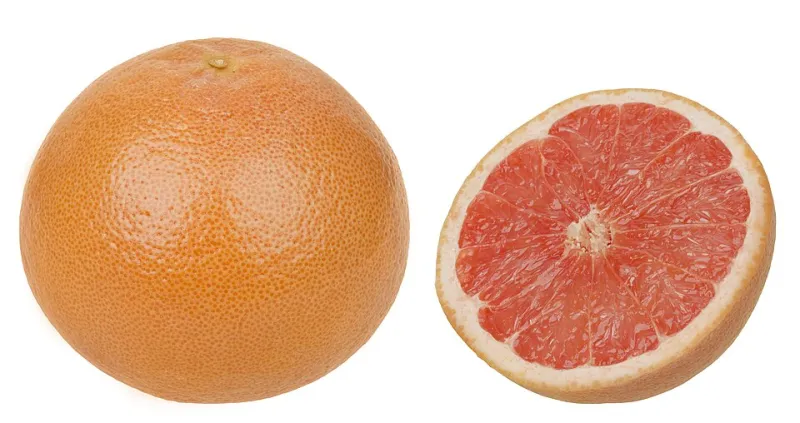
Photo: Evan-Amos, Public domain, via Wikimedia Commons
Most patients have heard a version of the warning: don't take your medication with grapefruit juice. Fewer understand why the warning exists, and fewer still realize it applies to the medications they take for erectile dysfunction.
The story begins with an enzyme most people have never heard of.
Meet CYP3A4: Your Liver's Processing Plant
The cytochrome P450 family of enzymes handles the breakdown of the majority of drugs on the market. Within that family, CYP3A4 does the heavy lifting for many medications — including sildenafil, the active ingredient in Viagra and its generics, and to a lesser extent tadalafil (Cialis).
When you swallow a sildenafil tablet, CYP3A4 in your liver and intestinal wall begins breaking it down at a predictable rate. That predictable metabolism is what allows prescribers to land on a dose — typically 50 mg for sildenafil — that is effective without being excessive.
Grapefruit disrupts this system. Compounds called furanocoumarins bind to CYP3A4 and effectively disable it, and the enzyme can't fully recover for 24 to 72 hours after exposure. Medication that would normally be metabolized lingers in the bloodstream at higher concentrations.
What That Means for Sildenafil and Tadalafil
Research on grapefruit juice and sildenafil has shown meaningful increases in drug exposure — in some studies, blood levels rose substantially when the two were taken together. Higher exposure doesn't make the medication work "better" in a useful sense. Instead, it raises the likelihood of dose-dependent side effects:
- Headache and facial flushing
- Dizziness, particularly when standing
- Nasal congestion
- Drops in blood pressure, which can be dangerous for men also taking nitrates or alpha-blockers
Tadalafil is less dependent on CYP3A4 for its initial pass through the body, but the interaction isn't zero. And because tadalafil remains in the system far longer than sildenafil, any interaction compounds across days of use.
It's Not Just Breakfast Juice
Patients are often surprised by how far the grapefruit effect reaches:
- Whole grapefruit and freshly squeezed juice carry the same furanocoumarins as commercial juice.
- Seville oranges (common in marmalade) and pomelos contain similar compounds.
- The effect is not dose-proportional — a single glass can suppress CYP3A4 for up to three days, so "I only had a little" doesn't provide a margin of safety.
Why This Matters Even More If You Take Statins
Many men treated for ED also take a statin for cholesterol, and several statins — simvastatin and lovastatin most notably — are heavily CYP3A4-dependent. If grapefruit is already raising your statin levels, adding an ED medication metabolized by the same enzyme stacks one interaction on top of another. This is precisely the kind of compounding effect a prescriber needs to know about, and precisely the kind patients forget to mention.
Practical Steps
- Ask your prescriber or pharmacist directly whether grapefruit is a concern for your specific medication and dose. Some patients on low-dose regimens may be given different guidance than others.
- Switch your citrus. Regular oranges, lemons, and limes do not inhibit CYP3A4 and are safe alternatives.
- Space doesn't fully solve it. Taking sildenafil hours after grapefruit juice doesn't eliminate the interaction, because enzyme suppression persists.
- Disclose everything. If you've consumed grapefruit within the past few days and experienced unusual side effects from your ED medication, tell your provider. It changes how they interpret the reaction.
Drug metabolism isn't abstract biochemistry — it's the reason your prescription comes with a dose, not a range. Protecting that system from interference, even from something as ordinary as breakfast fruit, is one of the simplest ways to keep your treatment predictable and safe.